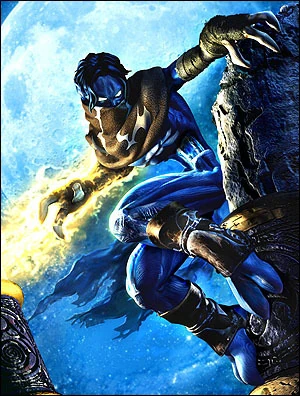
Legacy of Kain uses gothic fantasy to question truth, destiny, divinity, and whether a godlike authority should be trusted simply because it presents itself as holy.
Core idea
The series is not only about vampires, souls, and revenge. It is also about the collapse of inherited certainty. Characters discover that what looked like cosmic order may be manipulation, and that the difference between good and evil is harder to read than the world first suggests.
Raziel’s story begins with being cast out. He is punished for evolving beyond Kain and thrown into the abyss. That fall turns him into a seeker of truth, but also into a weapon used by forces he does not fully understand.
Questioning God

The Elder God appears as a divine voice, judge, and source of purpose. Raziel is told that his suffering has meaning because he has been chosen to restore balance.
But the deeper question is whether this “god” is actually good. The series turns religious obedience into a philosophical problem: if a being claims divine authority, how can Raziel know whether it is truth, justice, hunger, or manipulation?
Raziel
Raziel is tragic because he wants truth, but each truth breaks the identity he had before.
- As Kain’s lieutenant, he believes in hierarchy and power.
- After being cast out, he becomes driven by revenge.
- As Raziel learns more, revenge stops being enough: Kain is no longer just the enemy who betrayed him, but part of a larger web of prophecy, manipulation, and corrupted divine authority.
- His real struggle becomes understanding who is using him and what freedom is still possible.
Raziel is a character of disillusionment. He is repeatedly remade by knowledge. Seeing truth does not make him peaceful; it destroys simpler versions of himself.
Kain
Kain is not simply a villain. He is arrogant, violent, and manipulative, but he also sees farther than many characters around him.
His role is closer to the rebel tyrant: someone who refuses a destiny written by others, even if his rebellion causes suffering. Kain’s question is whether a corrupt world should be obeyed, restored, or broken open.
He understands that prophecy, morality, and divine command can be cages. That does not make him innocent, but it makes him more than evil.
Note for expansion
The main philosophical tension is that Raziel seeks truth through obedience and then through rebellion, while Kain seeks freedom by defying the structure of the world itself.